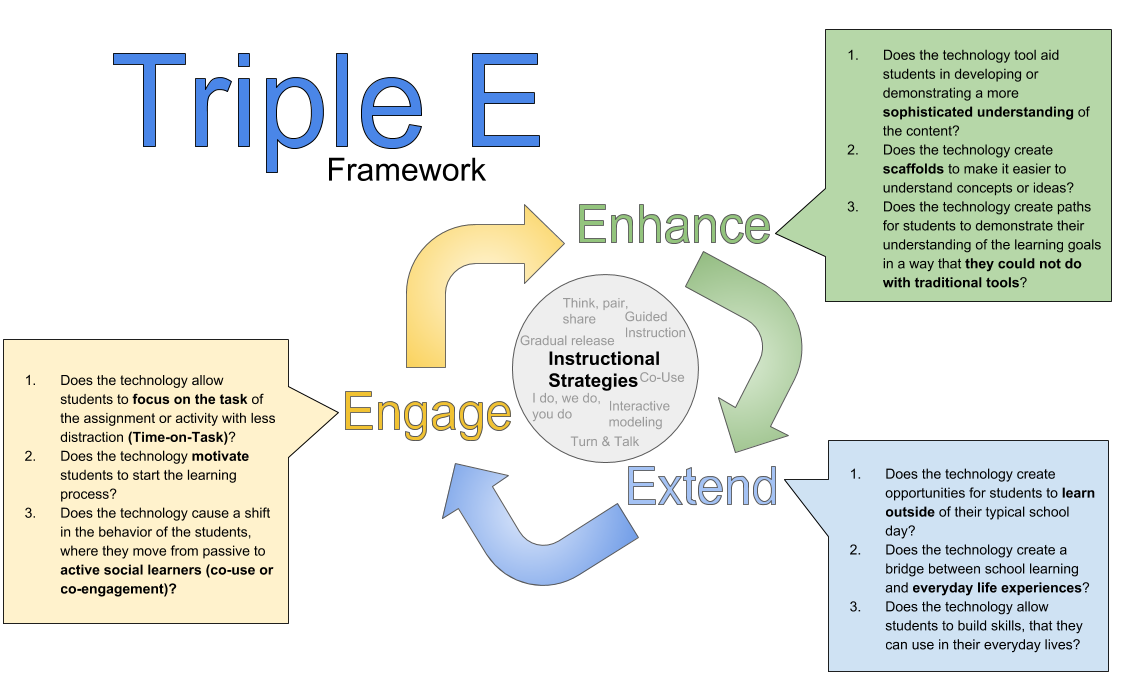
What is the Triple E Framework?
The Triple E Framework is a research-based tool that is designed to help teachers bridge the gap between technology use and learning in the field of education.
According to tripleeframework.com, the three E's stand for enhance, engage, and extend. The goal is for technology use in the classroom to meet this criteria in order for it to be put to good use. Just because technology is being used in the classroom doesn't mean it is appropriate for the lesson. It also doesn't mean it is being used to its full potential. Students should be engaged in what they are learning, as the technology enhances learning opportunities and extends their knowledge further.
When looking further into the website, I noticed that it allows teachers to take a several quick assessments in order to have a better idea of where they fall in meeting these categories. There is an assessment for writing a lesson, evaluating an already written/presented lesson, or an assessment for the use/quality of an application in the classroom. I really like that they have these different opportunities to evaluate and self-reflect. This can be done in the planning process, or reflecting after a lesson. Each rubric for the lesson assessments are broken up into three point-based categories: red light, yellow light, and green light. Green light is the highest category (13-18 points), yellow light is in the middle (7-12 points), and red light is the lowest category (6 points or below).
When further reflecting on my day to day lessons, technology this year has become more of a daily tool than in years past. After really targeting one specific area of improvement for myself, I have made it a goal to use technology to enhance instruction through clear/consistent procedures and expectations. I have been doing this by using a daily PowerPoint in which I display warm ups for the day, the daily agenda, a timer for transitions/pacing activities, CHAMPS/procedural expectations, and other content related to the lesson. I have noticed that this use of technology is engaging for students, enhances the overall feel of the classroom environment, and students are much more efficient with work completion.
This year we are also implementing a new science resource, which is mainly all online, called Amplify Science. Students are able to submit work, engage in polls, simulations, and check their progress all on the platform. Not only do they have access any time at school, but they also have access to the resource at home. The resource also has embedded homework assignments that encourage students to discuss or work with their families to answer.
I still think there is a lot of room for improvement because I just landed in the highest category by one point. After looking where I gave weaker points to myself, I realize I need to create more chances for students to extend their use technology to outside of the school day.
Below are some resources for learning about Amplify Science:
https://amplify.com/programs/amplify-science/?state=
https://www.edreports.org/reports/detail/amplify-science-6-8
Below is a resource for learning more about The Triple E Framework:
https://www.tripleeframework.com/about.html
When looking further into the website, I noticed that it allows teachers to take a several quick assessments in order to have a better idea of where they fall in meeting these categories. There is an assessment for writing a lesson, evaluating an already written/presented lesson, or an assessment for the use/quality of an application in the classroom. I really like that they have these different opportunities to evaluate and self-reflect. This can be done in the planning process, or reflecting after a lesson. Each rubric for the lesson assessments are broken up into three point-based categories: red light, yellow light, and green light. Green light is the highest category (13-18 points), yellow light is in the middle (7-12 points), and red light is the lowest category (6 points or below).
 |
| Image Source |
Self-Assessment and Reflection
After reflecting on my teaching last year, I took the assessment thinking I would score in the red to yellow categories. My main use of technology was putting student assignments on OneNote. However, I ended up scoring a 13/18. According to the rubric on tripleeframework.com, this shows that "when a lesson has at least 13 points, it is always meeting all three components of the Framework." The lesson being evaluated provides students with engagement, enhances the learning experience, and extends their use of content.When further reflecting on my day to day lessons, technology this year has become more of a daily tool than in years past. After really targeting one specific area of improvement for myself, I have made it a goal to use technology to enhance instruction through clear/consistent procedures and expectations. I have been doing this by using a daily PowerPoint in which I display warm ups for the day, the daily agenda, a timer for transitions/pacing activities, CHAMPS/procedural expectations, and other content related to the lesson. I have noticed that this use of technology is engaging for students, enhances the overall feel of the classroom environment, and students are much more efficient with work completion.
This year we are also implementing a new science resource, which is mainly all online, called Amplify Science. Students are able to submit work, engage in polls, simulations, and check their progress all on the platform. Not only do they have access any time at school, but they also have access to the resource at home. The resource also has embedded homework assignments that encourage students to discuss or work with their families to answer.
I still think there is a lot of room for improvement because I just landed in the highest category by one point. After looking where I gave weaker points to myself, I realize I need to create more chances for students to extend their use technology to outside of the school day.
Below are some resources for learning about Amplify Science:
https://amplify.com/programs/amplify-science/?state=
https://www.edreports.org/reports/detail/amplify-science-6-8
Below is a resource for learning more about The Triple E Framework:
https://www.tripleeframework.com/about.html
Thanks for a well thought out post. I really like how you were honest about this being one peek into a lesson and that it's possible not every lesson will score a "green" score. What also stood out was the comment about how technology is more of a basic tool in your classroom that is used often. This is great, and as you stated, allows you to really hone in on a specific segment of your reflection. Kudos!
ReplyDeleteThat is awesome that your new science resource is aligning to the Triple E framework! You and your students definitely deserve that. When you scored a 13/18, was there an E that fell the most short? What could you do to promote those levels? Are there any instructional strategies integrated within to help support the technology?
ReplyDeleteThe E related to extend fell most short. The Amplify resource does include homework opportunities for students to do specifically with their families, but sometimes, due to pacing, we don't get to the homework portion. Students might have other content that needs to be finished first. I think trying to implement a family related homework at least once a week would be help, as well as reaching out using applications such as Remind to communicate and include parents.
DeleteEven though you doubted yourself, you were actually addressing all the components of the framework- way to go! But I think it is great that you are still thinking about ways to engage your students while implementing a computer based resource. Keeping the excitement in learning and teaching with these resources can be challenging. I would love to see the Amplify in action. I'm curious about how the students respond to this resource.
ReplyDelete